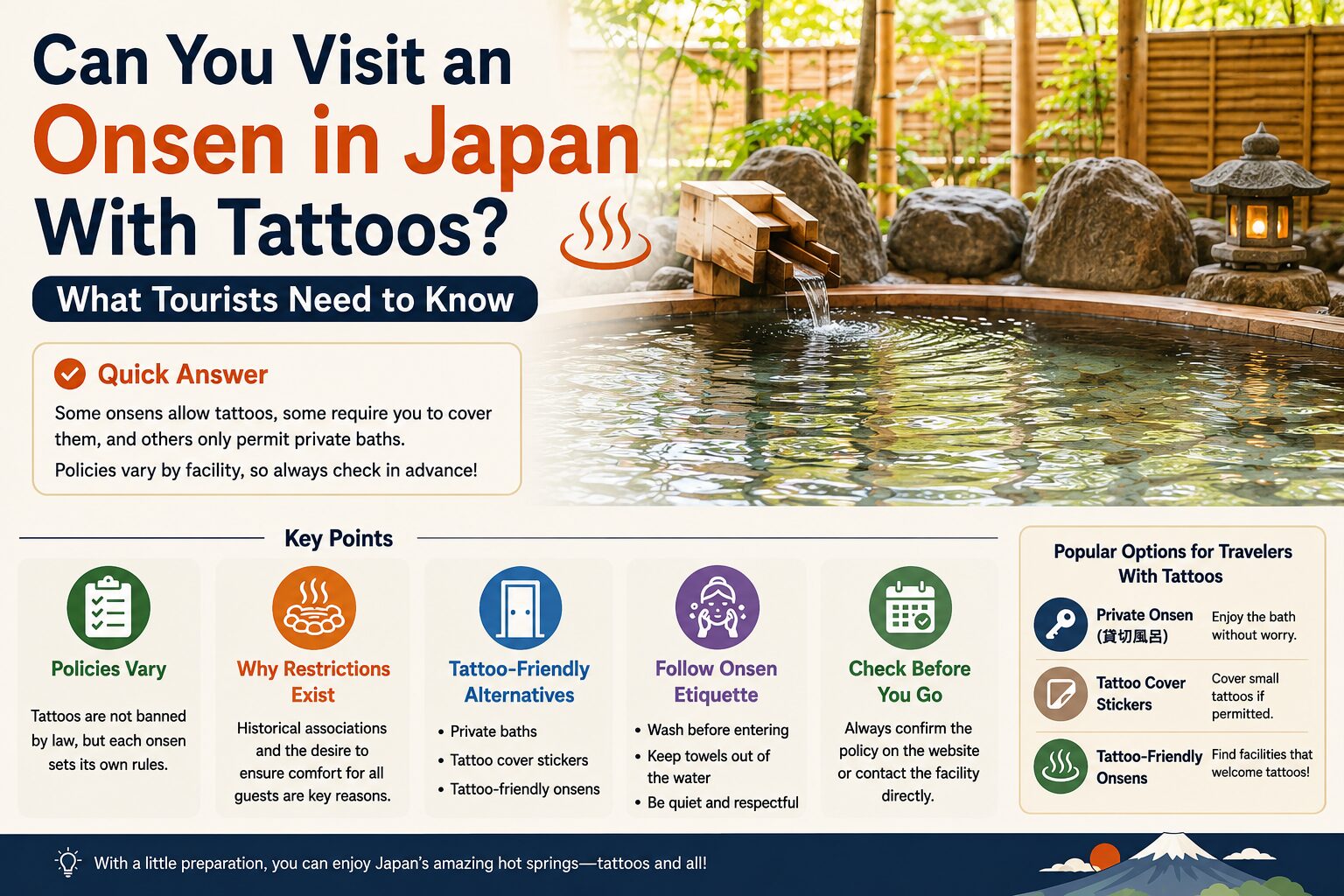
Can You Visit an Onsen in Japan With Tattoos? What Tourists Need to Know
Can You Visit an Onsen in Japan With Tattoos?
Visiting a traditional Japanese hot spring is a memorable experience, but travelers with tattoos may be unsure whether they will be allowed to enter.
The answer depends on the individual onsen. Some facilities welcome guests with tattoos, while others ask visitors to cover small tattoos or use a private bath. There are also onsens that do not allow tattoos in shared bathing areas.
This guide explains the basic tattoo rules at Japanese onsens, how to check a facility’s policy, and what alternatives are available if tattoos are restricted.
Quick Answer
Yes, you can visit some onsens in Japan with tattoos, but the rules vary by facility. Tattoo-friendly onsens may allow tattoos without restrictions, while others require small tattoos to be covered. Private baths are often the easiest option for travelers with larger tattoos.
1. Can You Enter an Onsen in Japan With Tattoos?
There is no single rule that applies to every onsen in Japan. Each hotel, ryokan, public bath, and hot spring facility can set its own admission policy.
Some onsens allow tattoos, some accept them only when covered, and others do not permit tattooed guests to use shared baths. For this reason, checking the facility’s policy before visiting is essential.
1-1. Tattoos are not prohibited by one nationwide onsen law
Having a tattoo does not automatically make it illegal to enter a hot spring. Tattoo restrictions are generally facility rules rather than one nationwide law banning tattooed visitors from all onsens.
However, staff may refuse entry when a facility clearly states that tattoos are not permitted. Visitors should respect the posted rules even when the tattoo is small or has no connection to organized crime.
1-2. Policies vary between facilities
A tattoo-friendly onsen may allow guests to enter a shared bath without covering their tattoos. Another facility may allow only small tattoos that can be completely hidden with an approved cover sticker.
Some hotels and ryokans may prohibit tattoos in their public baths but allow tattooed guests to reserve a private bath. The rules can differ even between facilities in the same town.
1-3. Check before making a reservation
The safest approach is to check the official website before booking. Look for information under sections such as bathing rules, frequently asked questions, guest policies, or onsen etiquette.
If the policy is unclear, contact the accommodation or bathing facility directly. Tell them the approximate size and location of your tattoo and ask whether a cover sticker or private bath is acceptable.
Questions to ask the facility
- Are tattoos allowed in the public bath?
- Can a small tattoo be covered with a sticker?
- Does the facility provide or sell tattoo covers?
- Is there a private bath available?
- Do private baths require an advance reservation?
Key Takeaway: Travelers with tattoos can use some onsens in Japan, but admission is not guaranteed everywhere. Always check the individual facility’s rules before visiting or making a reservation.
2. Why Do Some Onsens Restrict Tattoos?
Many international visitors wonder why tattoos are sometimes restricted at Japanese hot springs. The reason is largely historical and cultural rather than personal.
While attitudes toward tattoos have become more relaxed in recent years, some onsen operators continue to maintain long-standing policies to ensure that all guests feel comfortable.
2-1. Historical associations with organized crime
For many years in Japan, large traditional tattoos were commonly associated with organized crime groups. Because of this history, some hot spring facilities introduced rules restricting visible tattoos in communal baths.
Today, many staff members understand that foreign visitors often have tattoos for artistic, cultural, or personal reasons. Even so, some facilities continue to follow their existing policies rather than judging individual guests.
2-2. Providing a comfortable environment for all guests
Public baths are shared spaces where visitors expect to relax quietly. Some facilities believe that maintaining tattoo restrictions helps avoid misunderstandings or discomfort among guests with different cultural backgrounds.
The policy is generally intended to create a consistent bathing environment rather than to target international tourists.
2-3. Policies are gradually becoming more flexible
As international tourism has increased, more hotels, ryokans, and hot spring facilities have introduced tattoo-friendly options.
Some now allow small tattoos, provide tattoo cover stickers, or offer private baths that can be reserved by individuals, couples, or families. These changes make it easier for travelers with tattoos to enjoy Japan’s hot spring culture.
Good to Know
- Restrictions are usually based on facility policy rather than national law.
- Many tattoo-friendly onsens are now available throughout Japan.
- Private baths are becoming increasingly popular with international visitors.
- Respecting each facility’s rules helps create a pleasant experience for everyone.
Key Takeaway: Tattoo restrictions at some onsens are rooted in historical and cultural traditions. Today, many facilities are becoming more welcoming by offering tattoo-friendly policies or private bathing options.
3. Tattoo-Friendly Alternatives
Even if a public bath does not allow tattoos, there are several ways to enjoy Japan’s famous hot springs without missing the experience.
Many accommodations and onsen facilities now provide alternatives designed for guests with tattoos.
3-1. Reserve a private onsen
Private baths, often called kashikiri onsen or family baths, can usually be reserved for a specific time. Since you use the bath privately, tattoo restrictions are often less strict than in shared bathing areas.
3-2. Use tattoo cover stickers
Some onsens allow guests with small tattoos if they are completely covered using waterproof tattoo cover stickers.
If you plan to rely on this option, confirm with the facility in advance because not every onsen accepts cover stickers.
3-3. Choose a tattoo-friendly onsen
An increasing number of onsens openly welcome guests with tattoos. Many of these facilities clearly state their policy on their official websites, making them easy to identify before your trip.
Searching for tattoo-friendly onsens before traveling can save time and help you avoid disappointment after arriving.
Travel Tip
- Book private baths early during weekends and holidays.
- Check whether tattoo cover stickers are accepted before purchasing them.
- Look for the words “Tattoo Friendly” or “Tattoos Allowed” on official websites.
- When unsure, contact the facility before your visit.
Key Takeaway: Private baths, tattoo cover stickers, and tattoo-friendly onsens make it possible for most travelers with tattoos to enjoy Japan’s hot spring culture comfortably.
4. Onsen Etiquette for Visitors
Whether or not you have tattoos, following basic onsen etiquette helps ensure an enjoyable experience for everyone. Most bathing customs are simple and are intended to keep the hot spring clean and relaxing.
If you are visiting an onsen for the first time, learning a few basic rules before entering the bath can help you feel more confident.
4-1. Wash your body before entering the bath
Before getting into the hot spring, wash and rinse your entire body at the shower station. This is one of the most important customs at Japanese onsens and helps keep the shared bath clean for everyone.
4-2. Do not put towels in the water
Guests usually bring a small towel into the bathing area, but it should not touch the hot spring water. Many people place the towel on their head or leave it beside the bath while soaking.
4-3. Respect the atmosphere
Onsens are designed to be quiet places where people can relax. Speak softly, avoid splashing water, and be considerate of other guests using the bath.
Photography is generally not permitted inside bathing areas, so keep your phone and camera in the changing room unless the facility clearly allows otherwise.
Onsen Etiquette Checklist
- Wash thoroughly before entering the bath.
- Keep towels out of the hot spring water.
- Speak quietly and avoid disturbing others.
- Follow the facility’s tattoo policy.
- Do not take photos inside the bathing area.
Key Takeaway: Following basic onsen etiquette shows respect for local customs and helps create a relaxing environment for everyone using the hot spring.
5. Final Tips for Visiting an Onsen With Tattoos
Having tattoos does not automatically prevent you from enjoying Japan’s famous hot springs. While some facilities still restrict tattoos in shared baths, many others now welcome tattooed guests or provide practical alternatives.
By checking the policy in advance and respecting each facility’s rules, you can enjoy an authentic onsen experience without unnecessary stress.
Quick Summary
- Each onsen sets its own tattoo policy.
- Tattoo restrictions are based on facility rules, not a nationwide ban.
- Private baths are an excellent option for travelers with tattoos.
- Some facilities accept tattoo cover stickers for small tattoos.
- Many tattoo-friendly onsens can be found throughout Japan.
- Following onsen etiquette helps ensure a pleasant visit.
Key Takeaway: With a little preparation, travelers with tattoos can enjoy many of Japan’s hot springs. Research your destination, respect local rules, and choose the option that best suits your needs.
Frequently Asked Questions (FAQ)
Can foreigners with tattoos enter Japanese onsens?
Yes, many can. However, each onsen has its own policy. Some allow tattoos, some require small tattoos to be covered, while others only permit tattooed guests to use private baths.
Are tattoos illegal at Japanese hot springs?
No. There is no nationwide law that bans people with tattoos from using onsens. Restrictions are set individually by each facility.
What if I have a small tattoo?
Some onsens allow small tattoos if they are completely covered with a waterproof tattoo cover sticker. Always confirm the policy before your visit.
What is a private onsen?
A private onsen is a bath reserved for one person, a couple, or a family. These baths are often available to guests with tattoos, depending on the facility’s policy.
How can I find tattoo-friendly onsens?
Check the official website of the onsen or hotel before booking. Many tattoo-friendly facilities clearly state their policies online, and you can also contact them directly if you have questions.